
Tourism Beyond the Middle East: The Redistribution of Global Tourist Flows.
In recent weeks, experts across the global tourism industry have been closely analysing the consequences of the military conflict around Iran for international tourism. New estimates are emerging that help illustrate the scale of potential changes in the tourism market.
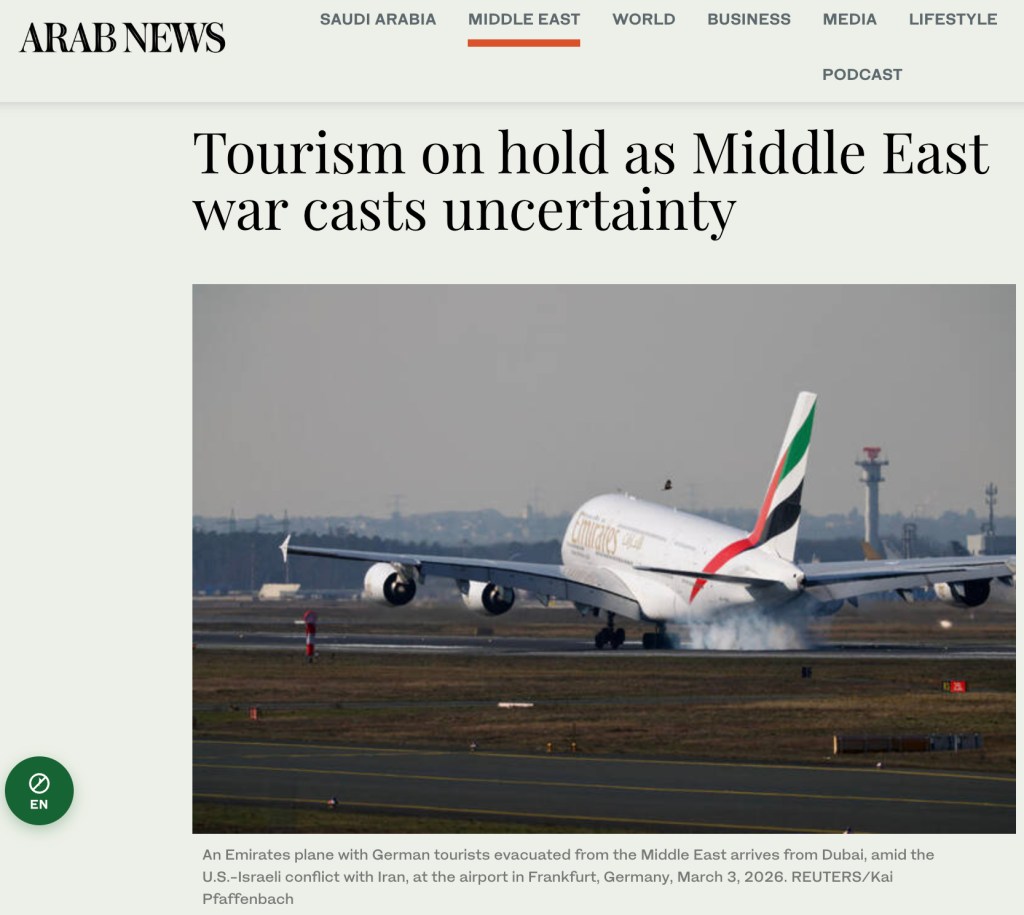
According to industry analysts and international media reports, in 2026, the countries of the Middle East may lose between 23 and 38 million tourists compared with previously projected figures. This would represent a decline of 11–27% in international tourist arrivals to the region.
In financial terms, this translates into losses of between $34 and $56 billion in tourism revenue. Reuters — https://www.reuters.com/world/middle-east/iran-conflict-threatens-gulf-tourism-undermining-years-investment-2026-03-03/
These projections are particularly striking given that 2025 was one of the most successful years for tourism in the region. According to various estimates, Middle Eastern countries welcomed around 100 million international visitors, reflecting the results of large-scale investments in tourism infrastructure and international promotion in recent years.
At the same time, airlines have already begun redistributing their routes, reducing some flights within the region while increasing frequencies to Europe and Asia, as travel demand patterns and the logistics of international air travel continue to shift. Reuters — https://www.reuters.com/business/lufthansa-reports-2025-operating-profit-beat-2026-outlook-murky-due-middle-east-2026-03-06/

However, one key question is hardly discussed in these analytical reviews: who will ultimately become the main recipients of these redistributed tourist flows?
Today, experts are calculating the number of tourists who will not travel to the Middle East and estimating the financial losses for the region. However, far less attention is being paid to which countries may benefit from this redistribution of the market.
In reality, what we are witnessing is a global redistribution of tourism flows across the world. According to current estimates, around 30 million tourists are already cancelling or reconsidering their plans to travel to the Middle East. Yet this does not mean they are giving up their holidays. They are simply choosing new destinations.
Interestingly, there is still little information on initiatives by national governments to attract these redirected tourism flows. Almost every day, we hear about instructions from presidents to their security and defence institutions to strengthen preparedness and forecasting for a wide range of possible scenarios related to developments in the Middle East. This is, of course, important.
However, global finance, logistics, and the tourism market also respond rapidly to geopolitical changes, and at such moments, the quality and speed of a country’s international communication in the financial, tourism, and logistics sectors become crucial in determining whether that country can successfully compete both for tourist flows and for investment flows.
Returning to tourism, it is reasonable to assume that some travellers will continue to choose destinations based on years of promotion of particular countries and regions and long-established global perceptions. Yet in today’s media environment, the situation can change very quickly.
For example, according to the Brand Finance Global Soft Power Index 2026, the soft power index of 50 leading countries looked like this: the United Arab Emirates ranked 10th, Qatar 20th, Kuwait 41st, and Bahrain 49th.
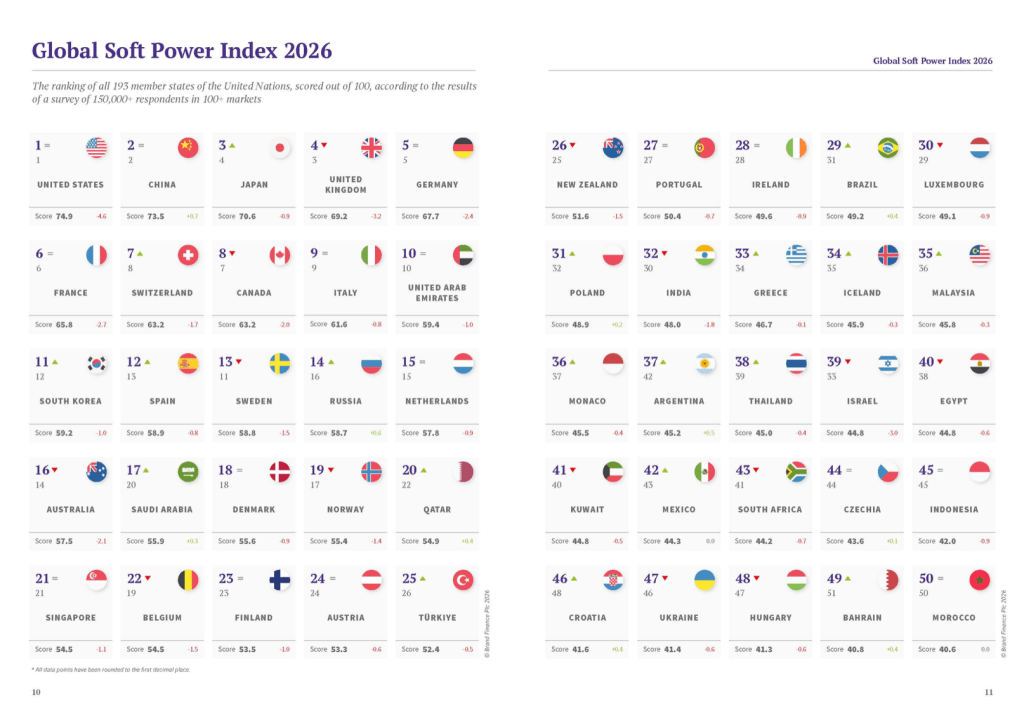
The Soft Power Index reflects how countries are perceived globally through the prism of national culture, tourism, sports, science, and education. To a large extent, this index helps explain both the strengths and weaknesses of national brands. A national brand is essentially a stable image — in simpler terms, a stereotype that exists in the global perception of a country.
Within just a few weeks, the international information environment can change dramatically, and it is precisely this environment that shapes international travellers’ perceptions and decisions when choosing a holiday destination. Spring is a particularly important period, as this is when travel plans for the 2026 tourism season are largely finalised. Under such circumstances, relying solely on local tourism exhibitions is no longer sufficient, because international tourists follow international news through international media platforms.
A clear illustration of this was the ITB Berlin international tourism fair, which opened just days after the beginning of military actions by Israel and the United States in Iran. As the largest event in the global tourism industry for many years, the 2026 edition of ITB Berlin experienced a noticeable decline in visitor attendance, as many participants were simply unable to arrive on time due to flight cancellations in Dubai, Abu Dhabi, Doha, Tel Aviv, and even Istanbul.
As for the participants who did attend, many of them spent a significant portion of their time monitoring developments in the Middle East, following updates on the websites of BBC, Reuters, and The New York Times, as well as watching international television news channels such as BBC News, CNN, Al Jazeera, and France 24 in their hotel rooms morning and evening.
For some countries, the military conflict in the Middle East represents serious challenges. For others, it creates unique opportunities. Destinations that were once outside the global information spotlight may now be able to attract international travellers with relatively limited effort. This is especially relevant at a time when major tourism destinations are still analysing the situation and have largely relied on previous logistical travel routes through Dubai, the United Arab Emirates, and other regional transit hubs.
Today, both airline routes and travellers’ plans are changing. As a result, the geography of international tourism itself is evolving. And at this moment, many countries have the opportunity to reshape the map of global tourism flows.
If you are interested in discussing this topic in more detail, we invite you to complete the form below and provide your corporate email address.

