

SHEIN After Its IPO: Why a Strong Consumer Brand Does Not Necessarily Mean a Strong Corporate Brand
On 1 September 2026, SHEIN shares began trading on the Hong Kong Stock Exchange. This followed several years of attempts by the company to pursue an IPO, first in New York, then in London, and finally in Hong Kong. Reuters has documented this journey in detail, including the regulatory and geopolitical complexities involved.
Reuters — SHEIN’s pursuit of an IPO: From New York to London to Hong Kong
SHEIN offered 280 million shares at HK$48.56 each, raising approximately $1.74 billion and achieving a valuation of around $26.5 billion. The contrast with the company’s previous valuation is particularly striking: Reuters reported that SHEIN had been valued at nearly $100 billion in the private market in 2022.
Reuters — SHEIN prices Hong Kong IPO below top end of range, raises $1.74 billion
The first day of trading was also subdued, with the shares closing almost exactly at the offer price. On the second day, they fell by more than 5%, closing at HK$46. Reuters attributed investor caution to slowing growth, shrinking margins, higher import costs in the United States and Europe, increasing competition and regulatory pressure.
Reuters — SHEIN shares slide more than 5% on second day of Hong Kong trading
In our view, however, the SHEIN story is interesting from another perspective. It illustrates a paradox relevant to virtually any large company dealing directly with mass consumers: an exceptionally strong and well-known consumer brand does not necessarily mean an equally strong corporate brand.
When the Product Is Better Known Than the Company
SHEIN has created one of the most recognisable consumer brands of the past decade. Its proposition requires almost no explanation: an enormous selection of fashionable clothing, rapid product turnover and very low prices.
This is an outstanding achievement in consumer marketing. Yet this is precisely where a problem arises that is by no means unique to SHEIN. The success of product marketing can sometimes overshadow the need to develop the corporate brand systematically.
Consumers may know perfectly well what a company sells, see its advertising regularly and use its products. But that does not necessarily mean that they — and even less so investors, journalists, government regulators, prospective employees or business partners — have equally clear, attractive and lasting associations with the company itself.
Harvard Business Review describes precisely this gap. Stephen Greyser and Mats Urde note that companies are generally good at defining their product brands, but are considerably less confident when it comes to their corporate brand: what the company name itself stands for, how the organisation is perceived by the market, and how corporate identity connects different stakeholder groups.
Harvard Business Review — What Does Your Corporate Brand Stand For?
The distinction between a product brand and a corporate brand is fundamental. Product marketing primarily answers the question: Why should I buy this product or use this service?
The corporate brand must answer a different set of questions: Who is this company? What does it stand for? Why should it be trusted? How does it conduct business? What role does it play in its industry and in society? Why should investors, governments, partners and the best employees want to work with it?
And the larger a company becomes, the more people begin asking precisely this second set of questions.
An IPO as a Stress Test for the Corporate Brand
This is why SHEIN’s IPO provides such an interesting case study. Going public did not create the corporate positioning challenge. It simply made it much more visible.
As long as a company’s primary audience is the consumer, communications can concentrate on the product, price, range, service and convenience. A public company, however, faces a considerably more complex stakeholder ecosystem: institutional and retail investors, analysts, financial journalists, government bodies, regulators, politicians, partners, employees and civil-society organisations.
Each audience requires its own professional language of communication.
Public Relations (PR) manages relationships with the media and the broader public information environment.
Government Relations (GR) provides systematic engagement with government institutions, policymakers and regulators.
Investor Relations (IR) is responsible for communications with existing and prospective investors, shareholders, analysts and the financial markets.
Public Affairs operates at the intersection of corporate reputation, public policy and engagement with government and other institutional audiences.
Marketing continues to communicate with consumers.
Internal Communications works with employees.
Corporate Affairs brings together various institutional relationships of the company.
Each function has its own objectives, tools, professional expertise and KPIs, but there is a question at a higher level:
What company are all these functions actually describing?
If each function independently defines the corporate narrative, a single organisation can end up telling several different stories about itself. This is where the strength — or weakness — of corporate branding and strategic communications becomes apparent. Their purpose is not to replace PR, GR, IR, Public Affairs or marketing.
The role of strategic communications is to define corporate positioning and create a system in which all these functions, while speaking to their respective audiences in the appropriate professional language, build a coherent and mutually reinforcing image of the same company.
SHEIN Had to Build a Separate Communications Infrastructure
The history of SHEIN’s IPO preparations provides a particularly revealing example.
On 2 May 2025, Reuters reported that SHEIN had stopped working with two major international communications firms — Brunswick and FGS Global — which had supported the company’s preparations for a potential London IPO. For our purposes, however, what is much more interesting than the termination of these contracts is the fact that they existed in the first place — and the division of responsibilities between the firms.
According to Reuters, Brunswick handled media relations, while FGS Global was responsible for government relations. Their contracts ended on 30 April 2025 and were not renewed as SHEIN’s plans for a London listing became increasingly complicated.

This fact in itself is highly revealing. One of the world’s best-known consumer-facing companies, equipped with an enormous marketing machine of its own, considered it necessary to use separate professional expertise in media relations and government relations as it prepared to enter the public markets.
Because this was no longer about advertising clothes. It was about communicating the company itself.
$1.28 Million on Lobbying: Communicating With an Entirely Different Audience
SHEIN’s experience in the United States illustrates even more clearly how the communications challenge changes.
On 3 December 2023, the Taipei Times reported that SHEIN had spent $1.28 million on lobbying on Capitol Hill during 2023, as the company was preparing to enter the US public markets: https://www.taipeitimes.com/News/editorials/archives/2023/12/03/2003810046
But more interesting than the amount itself is how the company used Government Relations. SHEIN held private meetings with US lawmakers, including some of the company’s most prominent critics. These engagements were aimed, among other things, at changing perceptions of SHEIN in Washington.
This represents a fundamentally different communications challenge. SHEIN’s consumer marketing needed to persuade someone to buy a dress, T-shirt or accessory. Government Relations and Public Affairs needed to explain the company itself to policymakers and government institutions — its supply chain, business model, product sourcing, relationship with China, and its position on issues that had attracted political criticism.
A consumer and a government regulator may be looking at the same company, but they make decisions in fundamentally different ways.
That is why enormous consumer awareness does not solve an institutional communications challenge.
From $1.28 Million to $3.9 Million: A System, Not a One-Off Campaign
Subsequent developments make the example even more revealing.
In May 2025, WIRED published an investigation based, among other sources, on internal SHEIN documents.
The publication obtained an eight-page internal company document from June 2023 entitled “U.S. Public Affairs Campaign Working Group List.” It described a substantial team of specialists in public affairs, government relations and lobbying. Areas of activity included US-China relations and media outreach.
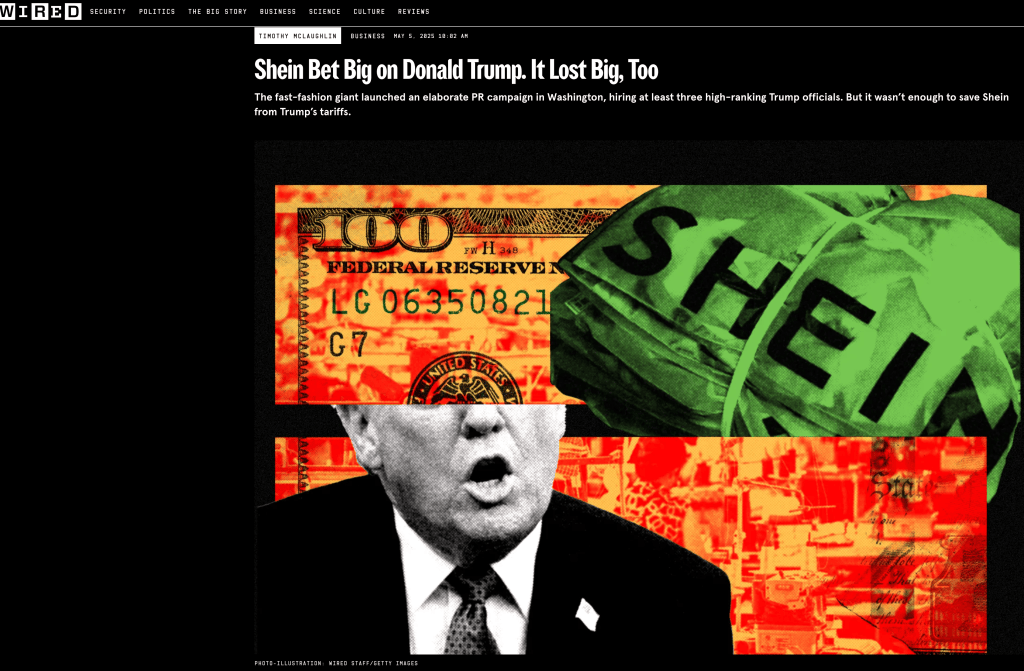
WIRED also documented the growth in spending. A company that had not registered the hiring of a federal lobbyist until 2022 spent $3.9 million on federal lobbying in 2024, followed by another $940,000 in the first quarter of 2025 alone. WIRED reported these figures on the basis of public records.
The progression — from the $1.28 million reported by Reuters in 2023 to $3.9 million in 2024 — matters not because of the numbers themselves.
It demonstrates the scaling of an entirely different type of communications infrastructure.
A company that had built an exceptionally effective system of
consumer → product → purchase
was simultaneously building another:
company → media → policymakers → regulators → investors → broader stakeholders.
These are different communications disciplines. But they must all support the same corporate brand.
Who Is SHEIN?
In SHEIN’s case, this question became particularly complex.
Reuters has described in detail how the company’s corporate identity itself became part of its multi-year IPO story. SHEIN was founded in China, subsequently moved its headquarters to Singapore and sought to position itself as a global company. But after unsuccessful attempts to pursue IPOs in New York and London, and as it prepared for a Hong Kong listing, the company had to place greater emphasis once again on its Chinese roots and its economic role in China.
Reuters — How Shein had to make peace with China to finally go public
According to Reuters, founder Sky Xu personally engaged with Chinese regulators. The company also committed to investing $1.5 billion in developing its supply chain in Guangdong and opened an R&D centre in Nanjing. Reuters described these steps as part of a broader rapprochement with the Chinese authorities on SHEIN’s path towards approval for its Hong Kong IPO.
From a corporate branding perspective, this is an exceptionally interesting example because one of the fundamental questions of corporate identity is remarkably simple:
Who are we?
Not what do we sell.
Not how much does our product cost.
But who are we as a company?
Where are our roots? What are our values? What is our role? With which country, industry, technology or system of values do we want to be associated?
If there is no clear answer — or if the answer continually changes depending on the audience — stakeholders inevitably begin answering the question themselves.
Awareness Is Not Reputation
Consumer-facing companies face another potentially dangerous trap: confusing awareness with reputation.
Enormous product recognition can easily create the impression that the company possesses equally enormous reputational capital.
But they are not the same thing.
In August 2026, less than a month before the IPO, YouGov analysed perceptions of SHEIN in the UK. Its Impression score — measuring whether consumers have an overall positive or negative view of a brand — stood at –19.4.
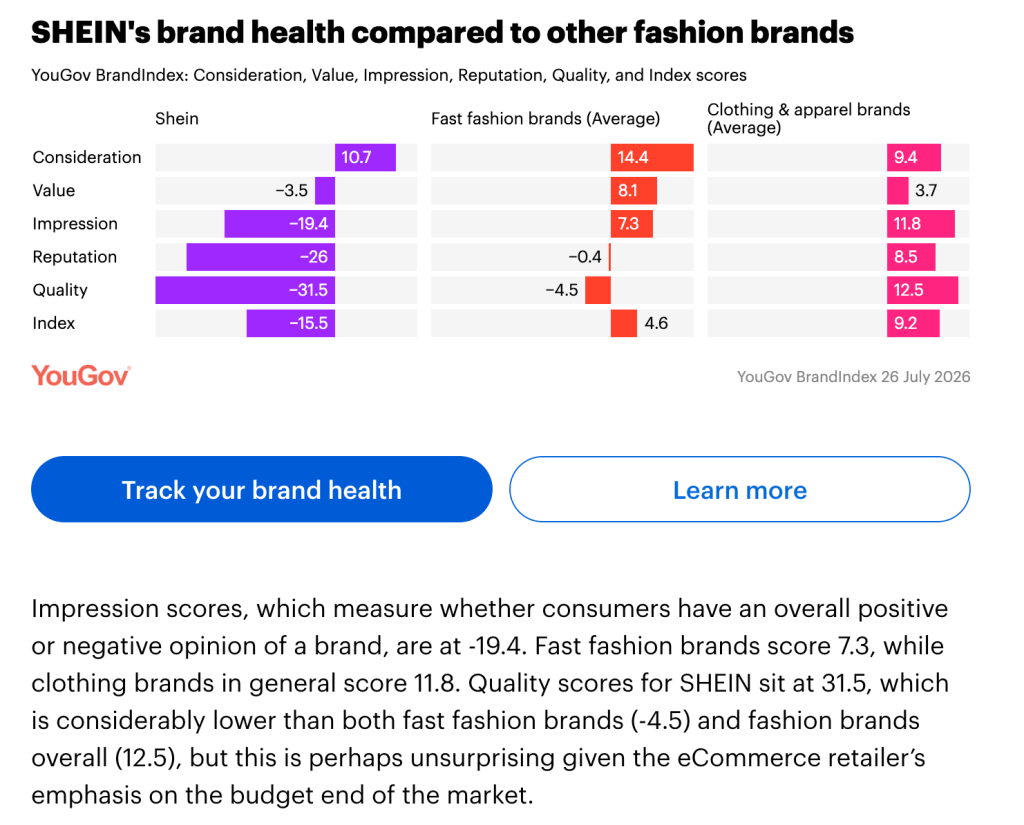
This allows us to formulate a simple distinction: Awareness ≠ Reputation.
A company can achieve enormous recognition.
It can have millions of customers.
It can build an exceptionally effective performance-marketing machine.
But none of this guarantees the creation of lasting positive associations with the company itself.
Academic research also confirms that the distinction between the product brand and the corporate brand has practical significance.
Harvard Business Review notes that a strong corporate identity can support a company’s reputation, assist recruitment and strengthen the position of its products.
In other words, corporate branding does not compete with consumer branding. It can reinforce it.
When Reputation Becomes a Financial-Market Issue
In SHEIN’s case, this gap moved well beyond a professional discussion among branding specialists.
In June 2024, Reuters reported that a number of ESG investors were concerned that a potential SHEIN listing could damage the reputation of the London Stock Exchange itself.
Their concerns centred on the supply chain, alleged labour-rights abuses, sustainability and governance. At the same time, other market participants argued that becoming a public company could force SHEIN to improve transparency and disclosure standards.
Reuters — Rumoured Shein listing could damage London Stock Exchange’s ESG reputation, say investors
This is a particularly powerful moment in the SHEIN story. The corporate reputation of a prospective issuer became part of a discussion about the reputation of the exchange itself on which its shares might have been listed.
Reputation ceases to be an abstract communications concept. It becomes part of the context in which investors, regulators and markets assess a company.
Even the CEO Becomes Part of the Corporate Brand
Following SHEIN’s Hong Kong listing, Reuters highlighted another detail.
The company’s founder and CEO, Sky Xu, maintained his characteristic low public profile even during the listing: he did not give a speech or participate in the traditional gong-striking ceremony, leaving the public role to the CFO. Reuters noted that Xu’s lack of public visibility contrasted with international norms for a company positioning itself as a global brand.

This, too, is part of corporate branding. The leader of a major company — whether or not he or she actively seeks the role — becomes one of the carriers of its corporate identity. A leader’s visibility or lack of visibility, speaking agenda, presence in international media, and relationships with government institutions and investors all create associations with the company.
Why SHEIN Is Not Just a Story About SHEIN
It would be a mistake to regard this case as something unique to fashion retail.
The same gap can emerge in virtually any rapidly growing consumer-facing company. Fintech provides an especially obvious example.
A fintech company can build an exceptionally strong consumer brand around a few simple promises: a convenient app, instant transfers, cashback, low fees, access to investments or immediate account opening.
Product marketing can make these benefits known to millions of people. But as the company grows, entirely different questions emerge:
Who owns it? How is it governed? How resilient is its infrastructure? How does it protect customer data? How does it engage with financial regulators? How does it respond to crises? What role does it want to play in the financial system? What is its international reputation?
Cashback advertising does not answer these questions.
The same applies to marketplaces, telecommunications companies, banks, airlines, automotive brands, food-delivery companies, technology platforms and manufacturers of consumer goods.
And once again, different professional communications functions come into play.
PR works with the media and the public information environment.
GR works with government institutions and regulators.
IR works with existing and prospective investors and analysts.
Public Affairs works within the institutional and public-policy environment.
Marketing works with customers.
Internal Communications works with employees.
Corporate Affairs works with the broader stakeholder ecosystem.
But if each of these functions independently determines what the company represents, fragmentation of the corporate brand becomes inevitable.
This Is Precisely Why Strategic Communications Matter
Corporate branding and strategic communications operate at a level above individual communications tools.
The process begins by defining which lasting positive associations a company wants people to connect with its name.
Innovative?
Reliable?
Global?
Responsible?
Technology-driven?
Open?
A national champion?
An international company with a distinctive heritage?
A leader in the transformation of its industry?
But defining these characteristics is not enough.
The company must substantiate them through its actions and then communicate them systematically to different audiences.
This is where PR, GR, IR, Public Affairs, marketing and other functions cease to operate as parallel communications streams and become components of a single system.
PR should not describe one company, GR another, IR a third, while consumer advertising creates a fourth image.
The audiences are different.
The tools are different.
The KPIs are different.
But there is only one corporate brand.
This is the role of strategic communications: not to perform the operational work of specialised communications teams, but to define corporate positioning, structure the communications architecture and create synergy between all these functions.
The IPO Is Merely a Moment of Truth
The principal lesson from SHEIN, therefore, is not that a company should hire good PR, GR or IR advisers before an IPO.
That conclusion would be far too narrow.
An IPO simply creates a moment when the strength or weakness of a corporate brand becomes particularly visible. A long-term reputation cannot be created in a few months.
Sustainable trust among investors, journalists, regulators, politicians, employees and society cannot be purchased overnight.
A company can conduct a roadshow.
It can prepare an investor presentation.
It can organise interviews.
It can appoint one communications consultancy for media relations and another for government relations, as SHEIN did. It can spend $1.28 million and subsequently millions more on lobbying and build a substantial Public Affairs infrastructure.
But all these professional tools work considerably more effectively when audiences already know the company before a specific transaction, crisis or regulatory challenge arises, and associate its name with a clear set of lasting positive attributes.
Corporate branding should therefore begin not immediately before an IPO, but long before an IPO even appears on the company’s calendar.
If a Company Does Not Define Its Own Corporate Narrative, Others Will
This is perhaps the most important conclusion from the SHEIN story.
Product marketing can make a product famous.
Performance marketing can make sales exceptionally effective.
Social media can generate enormous consumer awareness.
But none of this guarantees that the company has built an equally strong corporate brand. And there is never an information vacuum around a major company. If an organisation does not systematically explain who it is, what it stands for and what role it wants to play, others will begin providing those answers: journalists, investors, politicians, regulators, activists, competitors, employees and social media.
SHEIN is an especially interesting case study precisely because it allows us to observe both sides of this process simultaneously.
On one side is one of the best-known consumer brands of our time. On the other is years of work around corporate identity, media relations, government relations, Public Affairs, regulatory relationships and investor expectations — particularly visible throughout the company’s long journey from New York through London to Hong Kong.
This is why it is no longer enough for the leadership of any major consumer-facing company to ask:
“How well do people know our products?”
There is another question that is equally important:
“What lasting associations do consumers, investors, journalists, government officials, employees and partners have with the company itself when they hear its name?”
If the company does not have a clear answer, high product awareness has not yet been transformed into a strong corporate brand.
Product marketing creates demand. PR builds relationships with the media and the public information environment. GR builds relationships with governments and regulators. IR engages investors and financial markets. Public Affairs operates within the institutional and public-policy environment.
Corporate branding and strategic communications, however, should ensure that all these functions — while addressing different audiences and pursuing different professional objectives — create one coherent, consistent and compelling image of the same company.
It is this consistency that, over time, turns awareness into reputation — and reputation into sustainable trust.
If you would like to discuss with Dars Consulting’s advisers and experts whether your company’s corporate positioning matches the strength of its product brand, and how PR, GR, IR, Public Affairs and marketing can work within a unified communications strategy, please complete the short contact form below.

